When the time comes to move offices, upgrade your infrastructure, or transition systems into the cloud, your comms room is often left as the final challenge. Racks full of equipment, complex cabling, and sensitive data all need to be handled carefully. This is where a comms room decommission service becomes essential, giving you a clear, secure, and structured way to remove old IT infrastructure without risk to your business.
At its core, a comms room decommission is about far more than simply removing equipment. It involves the safe shutdown, dismantling, and removal of your network systems, servers, and associated hardware. It also ensures that any data held on those systems is handled securely, in line with UK regulations such as GDPR and WEEE. When done correctly, it protects your organisation, your customers, and your reputation.
You might be relocating to a new premises, consolidating multiple sites, or moving to a cloud-based setup. In each case, your goal is the same. You need a process that is efficient, secure, and causes minimal disruption to your operations. This is why many organisations search for server room decommissioning or data centre decommissioning services when planning their next steps. These broader terms reflect the same need for a structured, professional approach.
Without a clear plan, decommissioning can quickly become overwhelming. Loose cables, unidentified equipment, and unclear ownership of data can lead to delays, unexpected costs, and potential compliance issues. A well-managed decommission removes that uncertainty. It gives you clarity on what is happening, when it is happening, and how your assets are being handled.
The benefits are straightforward:
- Your space is cleared and ready for its next use
- Your data is securely handled and disposed of
- Your equipment is removed in a controlled and compliant way
- Your business avoids unnecessary risk and disruption
At ETS Group, we approach IT decommissioning services with your outcome in mind from the very beginning. Every step is planned to ensure your comms room is decommissioned efficiently, securely, and in full compliance with UK standards, so you can move forward with confidence.
If you are planning a move, upgrade, or closure and want clarity on how to handle your comms room safely, speak to our team today. Contact us through our enquiry page or call us on 0117 9414 666 to discuss your project and get clear guidance on your next steps.
What Is a Comms Room Decommission?
A comms room decommission is the structured process of safely shutting down, removing, and disposing of the IT and network infrastructure within your building. This typically includes server racks, switches, patch panels, structured cabling, power supplies, and any supporting hardware that keeps your systems connected.
For many organisations, this space has built up over time. Equipment has been added, upgraded, and replaced, often without a clear plan for removal. When the time comes to clear it, what looks like a single room can quickly reveal a complex network of systems that require careful handling.
Understanding What’s Included
A professional decommission goes far beyond unplugging equipment. It involves a controlled process that protects your data, your operations, and your compliance responsibilities.
From ETS this includes:
- Safe shutdown of live systems
- Identification and cataloguing of equipment
- Removal of server racks and networking hardware
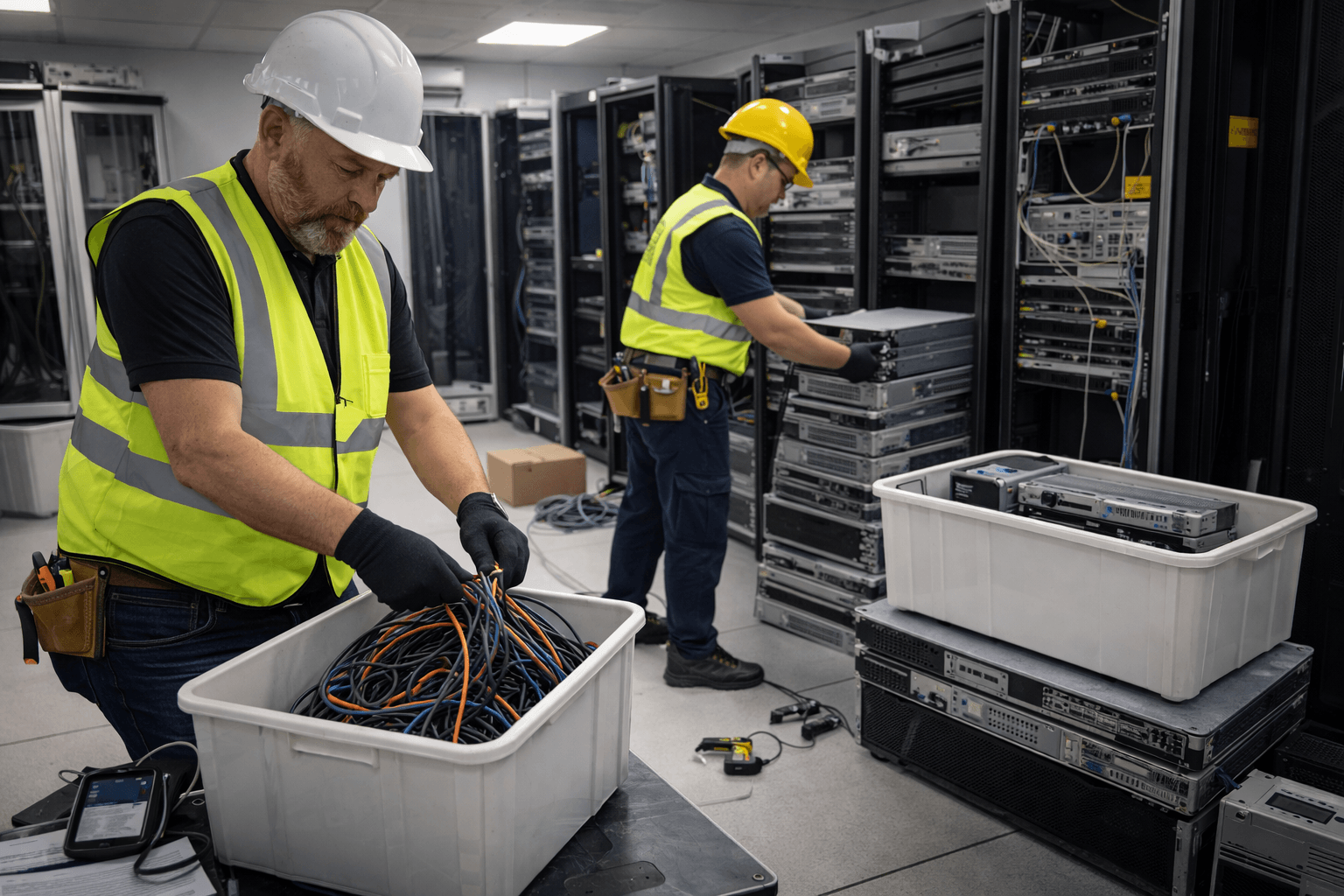
- Structured cabling removal
- Handling of power systems such as UPS units
- Secure data destruction where required
- Responsible recycling or disposal of IT assets
This is why the service is often grouped under broader terms such as server room decommissioning or data centre decommissioning services. Whether your space is a small comms room or a larger server environment, the principles remain the same. Everything must be removed methodically, securely, and in line with regulations.
The scale of electronic waste in the UK continues to grow, with millions of tonnes of waste electrical equipment generated each year. This highlights why responsible IT asset disposal and recycling are essential parts of any comms room decommission (source: Science Direct).
How It Relates to IT Asset Disposal
A key part of the process is IT asset disposal (ITAD). This ensures that any equipment leaving your site is handled correctly, with full traceability. It also means that sensitive data is permanently destroyed, not simply deleted.
From your point of view, this removes a major concern. You are not left wondering where your equipment has gone or whether your data could still be accessed. Instead, you have a clear, documented process that protects your organisation.
Why a Structured Approach Matters
Without a defined process, comms room decommissioning can create unnecessary risk. Equipment may be removed incorrectly, data may be left exposed, and valuable materials may be wasted.
A structured approach ensures:
- Your systems are shut down without disruption
- Your equipment is handled safely and efficiently
- Your data is protected at every stage
- Your site is cleared in a controlled and organised way
At ETS Group, we treat every comms room decommission as part of a wider operational plan. That means understanding your setup, your timelines, and your priorities before any work begins. The result is a process that works around your business, not against it.
If you need clarity on what your comms room decommission involves and how it can be managed without disruption, our team is ready to help. Contact us through our enquiry page or call our team on 0117 9414 666 to discuss your requirements and get a clear, practical plan in place.
Why You Might Need to Decommission Your Comms or Server Room
There are several points in the life of a business where a comms room decommission becomes necessary. In most cases, it is not a planned project from day one. It is triggered by change. That change might be growth, relocation, or a shift in how your systems are managed.
Understanding why you need to decommission your comms room helps you plan ahead and avoid unnecessary disruption.
Office Relocation or Site Closure
One of the most common reasons for server room decommissioning is moving premises. When you relocate, your existing infrastructure often cannot simply be unplugged and taken with you. It needs to be carefully dismantled, with cabling, racks, and equipment removed in a controlled way.
If a site is closing, the need becomes even more urgent. You are often working to a deadline, with landlords or new occupants expecting the space to be cleared. A structured data centre decommissioning service ensures the room is returned in a suitable condition without delays.
Moving to Cloud-Based Systems
Many organisations are reducing their reliance on on-site hardware by moving to cloud platforms. This removes the need for physical servers and network equipment, but it leaves behind the infrastructure that once supported them.
A comms room decommission allows you to:
- Remove unused hardware safely
- Eliminate unnecessary power and cooling costs
- Free up valuable space within your building
More importantly, it ensures that any data stored on legacy systems is handled securely before disposal.
Upgrading or Replacing Existing Equipment
Over time, equipment reaches the end of its lifecycle. Older systems can become inefficient, unreliable, and costly to maintain. When you upgrade, the previous infrastructure needs to be removed properly.
This is where IT decommissioning services play a key role. Instead of leaving outdated equipment in place or attempting to remove it internally, you can ensure everything is handled correctly from the outset.
Consolidation of Multiple Sites
If you are bringing several locations together into one central hub, you may be left with multiple comms rooms that are no longer required. Each of these spaces needs to be cleared, with equipment accounted for and data securely destroyed.
A coordinated approach to data centre decommissioning UK projects helps you manage this process across multiple sites, keeping everything consistent and compliant.
Reducing Risk and Ongoing Costs
Unused or partially decommissioned comms rooms can create ongoing issues. Equipment left powered can increase energy costs, and systems that are no longer monitored may present security risks.
By completing a full decommission, you:
- Remove unnecessary running costs
- Reduce potential security vulnerabilities
- Ensure your infrastructure reflects your current needs
At ETS Group, we focus on understanding why you need to decommission your comms or server room before recommending the best approach. This ensures the process aligns with your wider plans, whether that is relocation, upgrade, or consolidation.
If you are planning a move, system upgrade, or site closure and want to understand the safest way to proceed, speak with our team today. Contact us through our website enquiry page or call 0117 9414 666to arrange a discussion and take the first step towards a controlled, secure decommission.
What Happens During a Professional Decommission?
When you begin planning a comms room decommission, one of the first questions is simple. What actually happens on the day, and how is everything managed without disrupting your business?
A professional server room decommissioning process is structured, methodical, and designed around your environment. It is not a one-size-fits-all service. Instead, it is carefully planned to ensure your systems are handled safely, your data is protected, and your operations continue as smoothly as possible.
Step 1: Planning and Site Assessment
Before any equipment is touched, the process starts with a full assessment of your comms room.
This includes:
- Identifying all equipment within the space
- Understanding how systems are connected
- Reviewing access, power, and safety requirements
- Aligning the project with your timelines
This stage is essential. It ensures that your data centre decommissioning service is planned around your business, rather than causing unnecessary disruption.
Step 2: Data Handling and Security Measures
One of the most critical parts of any IT decommissioning service is how your data is managed.
Before equipment is removed, steps are taken to ensure:
- Sensitive data is identified
- Storage devices are handled securely
- Data destruction processes are planned
This may involve physical destruction or certified data wiping, depending on your requirements. The key outcome is simple. Your data is no longer accessible once it leaves your site.
Step 3: Controlled Shutdown of Systems
Once everything is prepared, systems are shut down in a controlled sequence.
This avoids:
- Unexpected downtime
- Damage to equipment
- Loss of critical data
For businesses still operating during the decommission, this stage is carefully coordinated to minimise impact.
Step 4: Equipment Removal and Dismantling
With systems safely shut down, the physical decommission begins.
This includes:
- Removal of server racks and cabinets
- Disconnection and extraction of network equipment
- Structured cabling removal
- Handling of power systems such as UPS units and PDUs
Each element is removed in a way that maintains safety, protects your building, and keeps the process organised.
Step 5: Recycling, Disposal, and IT Asset Tracking
After removal, equipment is processed through approved IT asset disposal UK channels.
This ensures:
- Compliance with WEEE regulations
- Responsible recycling of materials
- Full traceability of your assets
Where appropriate, equipment may be reused or repurposed. Where it cannot, it is disposed of in line with environmental standards.
Step 6: Final Clearance and Handover
The final stage is preparing your space for its next use.
This includes:
- Ensuring all equipment and cabling are removed
- Leaving the room clean and clear
- Providing full project documentation where required
You are left with a space that is ready for handover, refurbishment, or redevelopment.
Why This Process Matters to You
A structured comms room decommission gives you control and confidence throughout the project. Instead of uncertainty, you have a clear plan. Instead of risk, you have a managed process that protects your business at every stage.
At ETS Group, we manage every part of the decommission in-house, ensuring consistency from planning through to final clearance. This means you are not dealing with multiple contractors or unclear responsibilities. Everything is handled as one coordinated service, aligned with your goals and your timeline.
If you want a clear, step-by-step plan for your comms room decommission and a team that can manage the entire process from start to finish, get in touch today. Contact us through our enquiry page here, or call us on 0117 9414 666 to discuss your project and arrange a detailed assessment.
Protecting Your Data: Security, Compliance and Peace of Mind
When you are planning a comms room decommission, one concern sits above everything else. What happens to your data?
Servers, storage devices, and network equipment often hold sensitive information. This could include customer records, internal systems, financial data, or confidential communications. If that data is not handled correctly during a server room decommissioning, the consequences can be serious, both financially and reputationally.
Why Data Security Cannot Be Overlooked
Simply deleting files or powering down equipment is not enough. Data can still be recovered if devices are not properly treated. This is why a professional IT decommissioning service includes secure, verified data destruction as a core part of the process.
From your perspective, this gives you confidence that:
- Your data cannot be accessed once the equipment leaves your site
- You are meeting your legal responsibilities
- Your organisation is protected from potential breaches
Meeting GDPR and UK Compliance Standards
In the UK, data protection is governed by GDPR. This places a clear responsibility on your organisation to ensure that personal data is handled securely, even at the point of disposal.
Alongside GDPR, there are environmental regulations such as WEEE that govern how electrical equipment is disposed of. A compliant data centre decommissioning UK service ensures both areas are covered.
This means:
- Data is destroyed in a secure and auditable way
- Equipment is processed through approved disposal channels
- You receive documentation confirming compliance
Secure Data Destruction Methods
There are several ways data can be securely destroyed, depending on your requirements and the type of equipment involved.
These may include:
- Physical destruction of hard drives and storage media
- Certified data wiping processes
- Secure handling and transport of equipment prior to destruction
Each method is designed to ensure that your data is permanently inaccessible.
Maintaining a Clear Chain of Custody
One of the most important aspects of secure decommissioning is knowing exactly where your equipment is at every stage.
A professional service provides a clear chain of custody, meaning:
- Equipment is tracked from removal to final disposal
- Access is controlled throughout the process
- Documentation is available for audit purposes
This removes uncertainty and gives you full visibility over how your assets are handled.
Peace of Mind Throughout the Process
When data security is managed correctly, it removes one of the biggest stresses associated with a comms room decommission. You are not left questioning whether your information is safe or whether you have met your obligations.
At ETS Group, we build security into every stage of the decommissioning process. From initial planning through to final disposal, your data is treated with the highest level of care, ensuring compliance with UK regulations and protecting your organisation.
If you need reassurance that your data will be handled securely during your comms room decommission, our team is here to help. Contact us through our get in touch page or call us on 0117 9414 666 to discuss your requirements and ensure your project is managed with complete confidence.
What Happens to Your Equipment After Decommissioning?
Once your comms room decommission is complete and equipment has been removed from the site, the next question is an important one. What happens to your IT assets?
For many organisations, this is where uncertainty begins. Equipment may still hold value, contain sensitive data, or require careful handling to meet environmental regulations. A professional IT decommissioning service ensures that every item is dealt with responsibly, securely, and with full visibility.
Sorting and Assessing Your Equipment
After removal, your equipment is assessed to determine the most appropriate next step.
This typically involves:
- Identifying reusable or refurbishable equipment
- Separating items that require secure destruction
- Categorising assets for recycling or disposal
This stage ensures that nothing is overlooked and that each piece of equipment is handled correctly.
Reuse and Value Recovery
Where possible, equipment may still hold value. Servers, networking hardware, and components that are no longer needed by your business could potentially be refurbished or reused.
From your perspective, this can:
- Reduce overall project costs
- Support more sustainable practices
- Ensure useful equipment is not unnecessarily discarded
A structured IT asset disposal UK approach looks at these opportunities before moving to recycling or disposal.
Responsible Recycling and Disposal
For equipment that cannot be reused, recycling becomes the next step. This is carried out in line with WEEE regulations, ensuring that electrical waste is processed safely and responsibly.
This means:
- Hazardous materials are handled correctly
- Components are separated for recycling
- Waste is disposed of through approved channels
This is not just about compliance. It is about ensuring your organisation is acting responsibly and reducing environmental impact.
Secure Handling of Data-Bearing Devices
Any equipment that stores data is treated with additional care. Before disposal or recycling, devices go through secure data destruction processes.
This ensures:
- Data is permanently removed or destroyed
- Devices cannot be accessed once processed
- Your organisation remains compliant with GDPR
This step is fully documented, giving you confidence that your data has been handled correctly.
Full Traceability and Documentation
One of the key concerns during a server room decommissioning project is knowing where your equipment ends up. A professional service provides full traceability from removal through to final outcome.
You receive:
- Records of equipment processed
- Confirmation of data destruction
- Documentation supporting compliance
This gives you a clear audit trail, which can be important for internal reporting or regulatory requirements.
Why This Matters to You
Without a clear plan for what happens after removal, your comms room decommission is only half complete. Equipment left unaccounted for can create risk, both from a data security and compliance perspective.
At ETS Group, we ensure that every asset is tracked, assessed, and processed with care. Our approach to data centre decommissioning services focuses on giving you complete clarity, so you always know what has happened to your equipment and why.
If you want to ensure your IT assets are handled responsibly and securely after your comms room decommission, speak to our team today. Contact us through our enquiry page or call 0117 9414 666 to discuss your project and understand exactly how your equipment will be managed.
The Risks of Getting Comms Room Decommissioning Wrong
A comms room decommission might seem straightforward at first glance. Equipment is no longer needed, so it gets removed. However, when this process is handled without the right planning or expertise, it can quickly create serious issues for your business.
Understanding these risks helps you avoid costly mistakes and ensures your server room decommissioning is carried out safely and correctly.
Data Security Risks
One of the biggest dangers is leaving data exposed. Servers, hard drives, and storage devices often still contain sensitive information, even after they have been powered down.
If this data is not securely destroyed:
- It can be recovered by unauthorised parties
- Your organisation may face data breaches
- Customer trust can be damaged
A professional IT decommissioning service ensures that data is permanently destroyed before any equipment leaves your control.
Non-Compliance with Regulations
Failing to meet legal requirements can lead to significant consequences. In the UK, regulations such as GDPR and WEEE place clear responsibilities on how data and electrical equipment must be handled.
If your data centre decommissioning UK project is not compliant, you could face:
- Financial penalties
- Legal complications
- Reputational damage
Compliance is not optional, it must be built into the decommisiomning process from the beginning.
It is important to understand that simply deleting files is not enough when disposing of IT equipment. Guidance from UK institutions highlights that all data must be fully removed or destroyed before disposal to meet legal requirements, reinforcing the need for a structured and secure decommissioning process.
(source: https://www.aber.ac.uk/en/hse/a-to-z-topics/wastemanagement/weee/datadestruction/)
Business Disruption and Downtime
Without careful planning, decommissioning can interfere with your day-to-day operations. Systems may be shut down too early, critical connections may be disrupted, or key equipment may be removed before it is no longer needed.
This can result in:
- Unexpected downtime
- Loss of productivity
- Delays to your wider project
A structured approach ensures that your business continues to operate as required throughout the process and we work with you to ensure your business can still operate..
Health and Safety Concerns
Comms rooms often contain heavy equipment, complex cabling, and power systems. Attempting to remove these without the right knowledge or equipment can create safety risks.
These include:
- Injury from lifting or dismantling equipment
- Electrical hazards
- Damage to your building infrastructure
A professional team understands how to manage these risks safely.
Hidden Costs and Inefficiencies
What may appear to be a cost-saving approach can often lead to higher expenses in the long run. Poor planning can result in:
- Additional labour to correct mistakes
- Delays that impact your wider project timeline
- Improper disposal leads to further costs
A well-managed comms room decommission helps you avoid these unexpected expenses by getting it right the first time.
Lack of Traceability and Accountability
If equipment is removed without proper tracking, you may not know where your assets have gone or how they have been processed. This creates uncertainty, particularly when it comes to data-bearing devices.
Without clear documentation:
- You cannot prove compliance
- You have no audit trail
- You may be exposed to future risk
Why Getting It Right Matters
When decommissioning is handled correctly, these risks are removed. You gain a controlled, secure, and efficient process that protects your business at every stage.
At ETS Group, we approach every server room and data centre decommissioning service with risk in mind. By planning carefully, managing each step, and maintaining full visibility, we ensure your project is completed safely, compliantly, and without disruption.
If you want to avoid the risks associated with comms room decommissioning and ensure your project is handled correctly from start to finish, our team is ready to support you. Get in touch through our enquiry page, or call us on 0117 9414 666 to discuss your requirements and move forward with confidence.
How ETS Group Approaches Comms Room Decommissioning
When you are planning a comms room decommission, the outcome you want is simple. You need the job completed safely, securely, and without disruption to your wider plans. The challenge is finding a partner who delivers that consistently, with a clear process and accountability from start to finish.
At ETS Group, our approach to server room decommissioning is built around control, communication, and complete visibility. This ensures you always know what is happening, when it is happening, and how your infrastructure is being handled.
A Fully Managed, End-to-End Service
One of the key challenges in data centre decommissioning services is fragmentation. Multiple contractors, unclear responsibilities, and gaps between stages can create delays and risk.
We remove that complexity by managing the entire process in-house.
This means:
- One point of contact throughout your project
- A consistent approach from planning to final clearance
- No disconnect between data handling, removal, and disposal
For you, this creates a smoother experience and removes the need to coordinate multiple suppliers.
Planning That Works Around Your Business
Every comms room is unique. Equipment, layout, access, and operational requirements vary from site to site. That is why we start with a detailed understanding of your environment before any work begins.
Our planning focuses on:
- Your timelines and deadlines
- Your operational requirements
- Any live systems that must remain active
- Safe and efficient access to your comms room
This ensures your IT decommissioning service is aligned with your business, rather than causing disruption.
Clear Communication at Every Stage
Uncertainty is one of the biggest concerns during a decommissioning project. Not knowing what is happening or when can create unnecessary stress.
We address this by maintaining clear communication throughout:
- You know the scope of work from the outset
- You are kept informed as each stage progresses
- Any changes are discussed and agreed in advance
This gives you confidence that your project is under control.
Security and Compliance Built Into the Process
Handling your data and equipment correctly is not an add-on. It is part of the core service.
Our approach to IT asset disposal in the UK ensures:
- Data-bearing devices are handled securely
- Compliance with GDPR and WEEE regulations is maintained
- Equipment is tracked and documented throughout
This protects your organisation and provides the documentation you need for audit purposes.
Minimising Disruption to Your Operations
We understand that your business does not stop during a decommission. Systems may still be in use, and other teams may be working around the comms room.
Our process is designed to:
- Work within agreed timeframes
- Coordinate shutdowns carefully
- Keep disruption to a minimum
This allows you to continue operating while the decommission is carried out.
A Practical, Results-Focused Approach
At ETS Group, our focus is on delivering a clear outcome. Your comms room is decommissioned efficiently, your data is secure, and your space is ready for its next use.
We do not overcomplicate the process. Instead, we provide a structured, straightforward service that gives you confidence at every stage.
If you are looking for a partner who can manage your comms room decommission from start to finish with clarity and control, speak to our team today. Contact us through our enquiry page or call us on 0117 9414 666 to discuss your project and get a clear plan in place.
Comms Room vs Server Room vs Data Centre Decommissioning
When planning a comms room decommission, it is common to come across related terms such as server room decommissioning and data centre decommissioning services. While they are closely linked, there are important differences in scale, complexity, and approach.
Understanding these differences helps you choose the right service for your environment and ensures your project is managed correctly from the outset.
What Is a Comms Room Decommission?
A comms room is typically a smaller space within your building that supports your network infrastructure.
This usually includes:
- Network switches and routers
- Patch panels and structured cabling
- Small server setups
- Wall-mounted or floor-standing racks
A comms room decommission focuses on removing this infrastructure efficiently, often within a single site, with a clear and controlled process.
What Is a Server Room Decommission?
A server room is usually more complex. It often supports a wider range of systems and may include dedicated cooling and power infrastructure.
A server room decommissioning project may involve:
- Multiple server racks and cabinets
- Storage systems and backup devices
- Cooling units and airflow systems
- Higher power requirements
The process requires more coordination, particularly where systems are still live or being migrated.
What Is a Data Centre Decommission?
A data centre operates on a much larger scale. It may support multiple businesses or a large internal operation, with extensive infrastructure in place.
A data centre decommissioning UK project typically includes:
- Large volumes of servers and networking equipment
- Complex power distribution systems
- Advanced cooling and environmental controls
- Multiple phases of shutdown and removal
These projects require detailed planning, phased execution, and close coordination across multiple stakeholders.
Why This Matters to You
Choosing the right level of service ensures your project is handled correctly. A comms room may not require the same level of complexity as a data centre, but it still demands a professional approach to ensure:
- Your data is protected
- Your equipment is removed safely
- Your site is cleared efficiently
At ETS Group, we tailor our IT decommissioning services to match the scale and complexity of your environment. Whether you are dealing with a small comms room or a larger server infrastructure, you receive the same level of planning, control, and attention to detail.
If you are unsure which type of decommissioning service you need or how your project should be approached, our team can guide you. Get in touch through our enquiry page or call 0117 9414 666 to discuss your requirements and get clear, practical advice.
How Much Does Comms Room Decommissioning Cost?
One of the first questions most businesses ask is straightforward. What does a comms room decommission cost?
The honest answer is that pricing can vary depending on your setup, your requirements, and how the project is managed. Rather than a fixed figure, the cost is shaped by several key factors that influence the time, resources, and level of planning involved.
Understanding these factors helps you budget accurately and avoid unexpected costs later in the process.
Key Factors That Influence Cost
Every server room decommissioning project is unique, but there are common elements that will affect the overall cost.
1. Size and Complexity of Your Setup
The larger and more complex your comms or server room, the more time and coordination is required.
This includes:
- Number of racks and cabinets
- Volume of cabling and network infrastructure
- Presence of power systems such as UPS units
- Accessibility of the room
A small comms room may be completed quickly, whereas a larger environment will require a more structured approach.
2. Type and Volume of Equipment
The amount and type of equipment being removed plays a significant role.
For example:
- Standard network equipment is typically quicker to remove
- Large server arrays or storage systems require more handling
- Specialist equipment may need additional care
This directly impacts labour, transport, and disposal requirements.
3. Data Destruction Requirements
Secure data handling is a critical part of any IT decommissioning service.
Costs may vary depending on:
- The number of data-bearing devices
- The method of destruction required
- The level of certification or documentation needed
From your perspective, this is an area where cutting corners can create risk, so it is important it is handled correctly.
4. Location and Access
The physical location of your comms room can influence the complexity of the project.
Considerations include:
- Restricted access or tight spaces
- Multi-floor buildings without direct access
- Out-of-hours working requirements
These factors can affect the time needed to complete the decommission safely.
5. Recycling and Disposal Requirements
A compliant IT asset disposal UK process ensures equipment is handled responsibly, but this can also influence cost depending on:
- The volume of waste
- The type of materials involved
- Any hazardous components
Where equipment holds residual value, this may help offset some costs.
Avoiding Unexpected Costs
One of the biggest frustrations during a data centre decommissioning service is hidden costs. These often arise from poor planning or unclear scope at the beginning of the project.
A clear, structured approach helps you avoid:
- Delays caused by unidentified equipment
- Additional labour due to incomplete planning
- Compliance issues that require corrective action
At ETS Group, we focus on understanding your environment in detail before providing guidance. This ensures your comms room decommission is planned accurately, with a clear scope and no unnecessary surprises.
Value Beyond the Price
While cost is important, it should be considered alongside what you receive in return.
A professionally managed decommission provides:
- Security for your data
- Compliance with UK regulations
- Minimal disruption to your operations
- A clear, documented process from start to finish
This protects your business and often prevents far greater costs associated with mistakes or non-compliance.
If you are looking for clarity on the cost of your comms room decommission and want a realistic, transparent view based on your setup, speak to our team today. Contact us through our enquiry page or call 0117 9414 666 to discuss your requirements and receive clear, practical guidance tailored to your project.
How to Choose the Right Decommissioning Partner
Choosing the right partner for your comms room decommission is one of the most important decisions you will make in the process. The right team will give you clarity, control, and confidence. The wrong choice can lead to delays, risk, and unnecessary cost.
With so many providers offering server room decommissioning and data centre decommissioning services, knowing what to look for helps you make an informed decision.
Look for a Structured, End-to-End Service
One of the first things to consider is how the service is delivered. Is it fully managed, or are multiple parties involved?
An effective IT decommissioning service should cover:
- Planning and site assessment
- Data handling and destruction
- Equipment removal and dismantling
- Recycling and compliant disposal
- Final clearance and documentation
When everything is managed as one service, you avoid gaps, miscommunication, and delays.
Check Their Approach to Data Security and Compliance
Your data is one of your most valuable assets. Any provider you choose should treat it accordingly.
Ask how they handle:
- Secure data destruction
- GDPR compliance
- WEEE-compliant disposal
- Asset tracking and documentation
A reliable IT asset disposal UK provider will be able to clearly explain their process and provide evidence of compliance.
Experience with Similar Environments
Not all comms rooms or server environments are the same. The complexity can vary significantly depending on your setup.
Look for a partner who has experience with:
- Comms room decommission projects
- Server room decommissioning
- Larger data centre decommissioning UK projects where relevant
This ensures they understand the challenges and can plan accordingly.
Clear Communication and Project Visibility
A well-managed project depends on communication. You should always know what is happening and when.
A strong provider will:
- Clearly define the scope of work
- Provide timelines and expectations
- Keep you updated throughout the project
- Be available to answer questions when needed
This level of visibility removes uncertainty and helps your project run smoothly.
A Focus on Minimising Disruption
Your business may still be operating during the decommission. The process needs to work around your environment, not interrupt it.
Look for a team that plans carefully to:
- Coordinate system shutdowns
- Work within agreed timeframes
- Reduce impact on your day-to-day operations
This is particularly important for active sites or phased migrations.
Transparency Around Cost and Process
Clarity at the beginning of the project prevents issues later on. You should understand what is included, how the process works, and what outcomes to expect.
A reliable provider will:
- Offer a clear breakdown of the service
- Explain any variables that may affect cost
- Avoid vague or unclear proposals
This gives you confidence that your comms room decommission is being handled properly.
Why Businesses Choose ETS Group
At ETS Group, we focus on delivering a complete, controlled decommissioning service that puts your needs first. From initial planning through to final clearance, every stage is managed with clarity and accountability.
You benefit from:
- A fully managed, end-to-end service
- Secure and compliant data handling
- Clear communication throughout your project
- A process designed to minimise disruption
Our approach ensures your comms room decommission is completed efficiently, securely, and in line with your wider business goals.
If you are planning a comms room, server room, or data centre decommission and want a partner you can rely on, we are here to help. Contact us through our enquiry page or call 0117 9414 666 to discuss your requirements and take the next step with confidence.
Frequently Asked Questions: Comms Room Decommission
1. What happens to IT equipment during a comms room decommission?
During a comms room decommission, your IT equipment is carefully removed, tracked, and processed through a structured system. Depending on its condition, it may be reused, recycled, or securely destroyed, with full documentation provided so you know exactly what has happened to your assets.
2. How do you prevent data breaches during decommissioning?
Preventing data breaches is a critical part of the process. Data-bearing devices are securely handled and undergo certified data sanitisation or physical destruction, ensuring your information cannot be recovered once it leaves your site.
3. What is data sanitisation and why is it important?
Data sanitisation is the process of permanently removing data from storage devices so it cannot be accessed again. It is essential during any IT decommissioning service to ensure compliance with GDPR and to protect your business from potential data breaches.
4. Do you provide destruction certificates for data-bearing equipment?
Yes, destruction certificates are provided as proof that your data has been securely destroyed. This documentation is important for compliance, audits, and giving you peace of mind that your data has been handled correctly.
5. What happens to electronic waste after a comms room decommission?
Electronic waste is processed in line with UK regulatory standards, including WEEE compliance. Equipment is either recycled responsibly or disposed of through approved channels, ensuring minimal environmental impact.
6. What role does a project manager play in a decommissioning project?
An ETS dedicated project manager oversees your entire decommissioning process, ensuring everything runs smoothly. They coordinate planning, manage timelines, and act as your main point of contact, giving you clarity and control throughout the project.
7. Are cooling systems removed as part of a server room decommission?
Yes, cooling systems such as air conditioning units and airflow management systems can be safely removed as part of a server room or data centre decommission. These systems are handled carefully due to their complexity and environmental considerations.
8. How are uninterruptible power supplies (UPS) handled during decommissioning?
Uninterruptible power supplies are safely disconnected, removed, and processed in line with safety and environmental regulations. Due to their electrical components and batteries, they require specialist handling to ensure compliance and safety.
9. What regulatory standards need to be followed during decommissioning?
Decommissioning must comply with several UK regulatory standards, including GDPR for data protection and WEEE for electronic waste disposal. A professional service ensures all processes meet these requirements and provides documentation to support compliance.
10. Why is a risk assessment important before decommissioning begins?
A risk assessment identifies potential challenges such as data security, access issues, and safety concerns. This allows the decommissioning process to be planned carefully, reducing disruption and ensuring everything is handled safely.
11. What is included in an asset audit during a comms room decommission?
An asset audit involves identifying and recording all equipment within your comms room. This ensures nothing is missed, supports accurate planning, and provides a clear record of what has been removed and how it has been processed.
12. Can you recover value from old IT equipment?
Yes, through asset recovery, certain equipment may still hold value. Where appropriate, items can be refurbished or reused, helping to offset costs and reduce waste as part of your IT asset disposal process.
13. What does the decommissioning process involve from start to finish?
The decommissioning process typically includes a site survey, planning, risk assessment, equipment shutdown, removal, data destruction, and final clearance. Each stage is managed carefully to ensure security, compliance, and minimal disruption.
14. What is a site survey, and why is it necessary?
A site survey is an initial assessment of your comms or server room. It allows the team to understand your setup, identify any challenges, and plan the decommissioning process effectively, ensuring everything runs smoothly.
15. How long does a comms room decommission take?
The timeframe depends on the size and complexity of your setup. A small comms room may be completed quickly, while larger server rooms or data centres may require a phased approach to ensure everything is handled safely and efficiently.
If you are planning a comms room, server room, or full data centre decommission, you need a partner like ourselves who understands the bigger picture, not just the removal of equipment, but how it impacts your business, your data, and your future plans.
At ETS Group, we work with you from the outset, providing a fully managed service that covers everything from initial site survey and risk assessment through to secure data destruction, IT asset disposal, and final clearance. Our approach is built around clear communication, careful planning, and a genuine focus on delivering the outcome you need, with minimal disruption and complete confidence in the process.
Working across the UK, we support businesses of all sizes with tailored IT decommissioning services that prioritise security, compliance, and efficiency at every stage. If you want a team that will guide you, manage every detail, and ensure your project is handled properly from start to finish, contact us today through our website enquiry page or call us on 0117 9414 666 to start the conversation.
Additional Reading
UPS Decommissioning, Relocation or Removal
(source: https://www.etsgroupofcompanies.co.uk/ups-decommissioning-uk/)
Data Centre and Communication Centre Decommissioning Contractors
(source: https://www.etsgroupofcompanies.co.uk/data-centre-decommissioning-services/)
Temporary Site Services UK
(source: https://www.etsgroupofcompanies.co.uk/temporary-site-services-uk/)
Refurbishment & Fit-Out Services UK
(source: https://www.etsgroupofcompanies.co.uk/refurbishment-fit-out-services/)
How to Choose the Right Electrical Contractor in the UK for Your Commercial Project
(source: https://www.etsgroupofcompanies.co.uk/electrical-contractor-uk/)
Electrical, Mechanical & Construction Site Services UK: Your All-In-One Contractor
(source: https://www.etsgroupofcompanies.co.uk/electrical-mechanical-construction-site-services-uk/)
Trusted Construction Site Services in the UK(source: https://www.etsgroupofcompanies.co.uk/construction-site-services/)