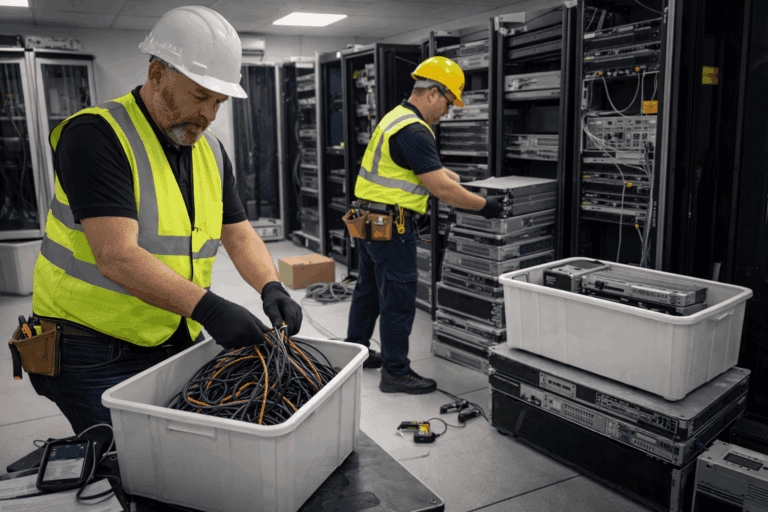

UPS Decommissioning, Relocation or Removal
Decommissioning a UPS is a critical step in protecting your business, your people, and your compliance responsibilities when a power system reaches the end of its life. A UPS is a battery-backed energy system that carries electrical, environmental, and legal risk if handled incorrectly. Whether you are upgrading infrastructure, closing a site, or managing ageing batteries, a planned and professionally managed UPS decommissioning process ensures safety, continuity, and full compliance with UK regulations from start to finish.
Why Decommissioning a UPS Is Not Just “Switching It Off”
When a UPS reaches the end of its working life, it can be tempting to view it as just another piece of electrical equipment that can be disconnected and removed. In reality, UPS decommissioning in the UK is a regulated, safety-critical process that directly affects your people, your premises, and your legal responsibilities. Understanding this from the outset helps you avoid unnecessary risk, disruption, and compliance issues later on.
A modern Uninterruptible Power Supply is designed to store and release energy instantly. Even when it appears inactive, it can still hold dangerous electrical charge and contain hazardous batteries that fall under strict UK waste regulations. From a business perspective, this means decommissioning must be planned, controlled, and carried out by engineers who understand both the electrical and environmental implications.
Why a UPS cannot simply be powered down and removed
UPS systems are often hard-wired into live infrastructure. This may include data centres, server rooms, manufacturing environments, healthcare settings, or commercial buildings where uptime is critical. A poorly managed shutdown can lead to:
- Sudden loss of power to essential systems
- Damage to connected equipment
- Safety risks for staff and contractors
- Data loss or unplanned downtime
The cost of an incorrect approach is rarely limited to the UPS itself. It can affect your operations and compliance status in one step.
Hidden risks inside an end-of-life UPS
One of the most commonly misunderstood aspects of UPS disposal in the UK is the battery system. Most units contain lead-acid or lithium-ion batteries, both of which are classed as hazardous waste. These batteries can present:
- Fire and thermal runaway risks
- Chemical exposure hazards
- Environmental contamination if mishandled
UK legislation requires these batteries to be removed, transported, and recycled at licensed facilities under WEEE and hazardous waste regulations. This is not optional, and responsibility ultimately sits with you as the asset owner.
What proper UPS decommissioning protects you from
When UPS decommissioning is carried out correctly, it safeguards your business in several ways:
- Your site remains safe during and after the shutdown
- You remain compliant with environmental and waste legislation
- You receive documented proof of disposal and recycling
- You reduce the risk of fines, audits, or insurance issues
This is where working with a specialist is important. At ETS Group, we approach UPS decommissioning as a controlled engineering project, not a removal task. That means your systems, staff, and obligations are protected at every stage, from isolation through to certified recycling.
If you are planning a system upgrade, site move, or data centre change, contact us today on 0117 9414 666 to discuss your UPS decommissioning requirements. You can also complete our contact form to speak with an engineer who understands how to protect your business from unnecessary risk.
What UPS Decommissioning Means for Your Business
UPS decommissioning is a structured engineering process designed to safely remove an Uninterruptible Power Supply from service without putting your people, systems, or compliance at risk. For your business, it is about controlling risk, maintaining continuity, and meeting your legal obligations at the point a UPS reaches end of life.
When handled correctly, UPS decommissioning in the UK ensures your infrastructure is protected, hazardous components are managed responsibly, and your organisation remains compliant with environmental legislation. When handled incorrectly, it can expose you to safety incidents, downtime, and regulatory scrutiny.
A controlled process, not a single action
As a business, UPS decommissioning should feel calm, planned, and predictable. In practice, it involves several coordinated stages, each with its own safety and compliance requirements.
Safe shutdown and electrical isolation
Before any physical work begins, the UPS must be shut down in a controlled way. This ensures:
- Connected systems are not suddenly interrupted
- Residual electrical energy is safely discharged
- The UPS is fully isolated from the mains supply
This stage is particularly important in data centres and live environments, where even a brief loss of power can have serious operational consequences.
Battery removal and hazardous waste handling
UPS batteries are the most regulated component of the system. Whether lead-acid or lithium-ion, they must be removed by engineers who understand their behaviour, weight, and storage risks. Under UK law, these batteries are classed as hazardous waste and must be:
- Handled safely on site
- Packaged and labelled correctly
- Transported by licensed carriers
- Recycled at approved facilities
This ensures your business meets its responsibilities under WEEE and hazardous waste regulations.
Disconnection, dismantling, and removal
Once the UPS is electrically safe and batteries are removed, the unit itself can be disconnected, dismantled, and prepared for removal. This may involve working in confined spaces, managing heavy components, or coordinating specialist lifting. A professional approach prevents damage to surrounding infrastructure and keeps your site operational.
What you gain from a professional UPS decommissioning service
Choosing a structured UPS removal and recycling service gives you practical and commercial advantages:
- Reduced health and safety risk on site
- Clear planning around downtime and access
- Certified recycling and disposal of all components
- Full documentation to protect your business
At ETS Group, we manage the entire process in-house, giving you a single point of accountability from shutdown through to disposal. That means fewer contractors, fewer handovers, and less risk for you.
If you need clarity on what UPS decommissioning involves for your site, call us today on 0117 9414 666 to speak to our engineering team. You can also fill out our contact form to discuss your system, timeline, and compliance requirements in confidence.
When and Why You May Need to Decommission a UPS
UPS decommissioning is usually triggered by a specific business event, but the underlying reason is always the same: the system is no longer suitable, safe, or efficient for your operational needs. Knowing when decommissioning is required allows you to plan ahead, reduce risk, and avoid rushed decisions that can affect safety and compliance.
For many organisations, UPS decommissioning in the UK is part of a wider change, such as growth, relocation, or infrastructure modernisation. For others, it becomes necessary because ageing batteries or legacy systems introduce unacceptable levels of risk.
Battery end-of-life and performance decline
UPS batteries have a finite lifespan. In most commercial environments, batteries require replacement every three to five years. As batteries age, they become less reliable and more hazardous.
Signs that decommissioning may be required include:
- Reduced runtime during power interruptions
- Increased battery alarms or fault warnings
- Visible battery swelling, corrosion, or leakage
- Rising maintenance costs with declining performance
Continuing to operate an ageing UPS can expose your business to sudden power failure and battery safety risks. In many cases, decommissioning and replacement is the most responsible option.
System upgrades and energy efficiency improvements
As technology advances, older UPS systems often struggle to meet modern efficiency standards. Newer systems offer improved energy performance, lower heat output, and better monitoring capabilities.
Decommissioning an existing UPS becomes necessary when:
- You are upgrading IT or data centre infrastructure
- Your power demand has changed
- Energy efficiency targets are being reviewed
- Manufacturer support for the existing system has ended
From your perspective, this creates an opportunity to improve resilience while reducing operational costs.
Data centre closure, migration, or consolidation
Data centre changes are one of the most common reasons for UPS removal and decommissioning. Whether you are consolidating sites, moving workloads to a new location, or transitioning to cloud services, legacy power systems must be dealt with safely and legally.
UPS decommissioning is often required when:
- A data centre is closing or downsizing
- Equipment is being relocated to a new site
- Redundant power infrastructure is being removed
In these scenarios, careful planning ensures power is removed without disrupting remaining services.
Business relocation or site shutdown
When moving premises or closing a site, UPS systems are frequently overlooked until late in the process. This can create delays if hazardous waste removal has not been factored into the project timeline.
Decommissioning allows your UPS to be:
- Safely removed before the handover of the building
- Relocated to a new site if appropriate
- Disposed of with full environmental compliance
Early planning helps you avoid last-minute issues that can affect lease agreements and project deadlines.
Managing compliance and corporate responsibility
Environmental compliance is an increasing priority for many organisations. UPS systems fall under WEEE regulations, and failure to manage disposal correctly can leave your business exposed to penalties and reputational risk.
Decommissioning at the right time ensures:
- Hazardous batteries are recycled responsibly
- Waste documentation is in place
- Your environmental obligations are met
At ETS Group, we help you identify the right moment to decommission and manage the process in a way that aligns with your operational and compliance goals.
If you are unsure whether your UPS has reached the end of its life or needs to be removed as part of a wider project, reach out to us today on 0117 9414 666 for clear, practical guidance. We can arrange a discussion about your site, system age, and next steps.
The Risks of Getting UPS Decommissioning Wrong
UPS decommissioning carries real consequences when it is rushed, improvised, or handled by teams without the right technical and regulatory understanding. From your perspective, the risks extend well beyond the physical removal of equipment. They can affect safety on site, operational continuity, environmental compliance, and your wider business reputation.
In the UK, UPS disposal and battery handling are regulated activities. Failing to meet those obligations can leave your organisation exposed to incidents that are difficult and costly to resolve after the event.
Electrical safety and residual energy risks
A UPS is designed to deliver power instantly during an outage. Even after a shutdown, residual energy can remain within the system. If isolation is incomplete or incorrectly carried out, this can result in:
- Electric shock or arc flash risk
- Damage to connected infrastructure
- Unsafe working conditions for staff or contractors
These risks are amplified in live environments such as data centres, healthcare settings, and industrial facilities, where multiple systems are interconnected.
Fire and battery failure hazards
UPS batteries are one of the most underestimated hazards during decommissioning. Lead-acid and lithium-ion batteries can become unstable if mishandled, damaged, or stored incorrectly. Risks include:
- Overheating and fire
- Chemical leakage
- Thermal runaway in lithium-ion cells
Incorrect battery removal or temporary storage can put your premises and personnel at risk, even after the UPS has been disconnected.
Environmental and regulatory exposure
Under UK law, UPS batteries and electrical components are classed as regulated waste. If disposal is not handled correctly, your business remains legally responsible.
Potential consequences include:
- Breach of WEEE regulations
- Failure to meet hazardous waste requirements
- Lack of valid waste transfer documentation
- Enforcement action or financial penalties
For many organisations, the greatest risk is not the work itself, but the absence of paperwork proving that disposal was carried out correctly.
Operational disruption and unplanned downtime
Poorly planned UPS decommissioning can interrupt critical systems, especially if dependencies are not fully understood. This can lead to:
- Unexpected loss of power
- Service outages
- Delays to wider projects or relocations
Downtime caused by avoidable errors can quickly outweigh the cost of professional UPS support.
Reputational and insurance implications
If an incident occurs during UPS removal, insurers and auditors will expect evidence that appropriate procedures were followed. A lack of certified documentation or the use of unqualified providers can complicate claims and investigations.
At ETS Group, we approach UPS decommissioning in the UK with a risk-managed methodology that prioritises safety, compliance, and continuity. Every stage is planned, documented, and executed to protect your business from avoidable exposure.
If you want to avoid unnecessary risk during UPS removal or disposal, speak to our engineering team today on 0117 9414 666. You can also use our contact form to outline your concerns and arrange a controlled decommissioning plan tailored to your site.
Our Step-by-Step UPS Decommissioning Process
A successful UPS decommissioning project relies on structure, foresight, and accountability. From your perspective, the process should feel organised and controlled, with no surprises and no last-minute changes that put safety or compliance at risk. Our role is to manage every stage clearly, so you always know what is happening, why it is happening, and how it protects your business.
Our UPS decommissioning service in the UK follows a defined sequence designed to reduce disruption, control hazards, and meet regulatory requirements without slowing your wider project.
Initial site assessment and planning
Every UPS system is installed within a unique environment. Before any shutdown or removal takes place, we carry out a detailed site assessment. This allows us to understand:
- The size, type, and condition of the UPS
- How it is connected to your power infrastructure
- Battery chemistry and storage layout
- Access constraints and lifting requirements
- Operational dependencies that could be affected
This planning stage is critical and ensures your UPS decommissioning aligns with your operational timetable and avoids unplanned interruptions.
One factor that often determines whether a UPS decommissioning project runs smoothly is the condition of the surrounding infrastructure rather than the UPS itself. During site assessments, our experienced engineers regularly identify ageing cable containment, undocumented modifications, restricted access routes, or redundant electrical connections that were never recorded after previous upgrades. Discovering these issues on the day of removal can delay critical programmes, increase costs, and introduce avoidable safety risks. Having supported complex electrical infrastructure projects since 1979, ETS Group understands the importance of identifying these hidden constraints before work begins, allowing realistic sequencing, safer isolation procedures, and better coordination with other contractors. Our proactive approach not only reduces disruption during decommissioning but also provides clients with greater confidence that replacement systems, refurbishments, or site closures can proceed without unexpected complications affecting programme deadlines or regulatory compliance.
One factor that often determines whether a UPS decommissioning project runs smoothly is how thoroughly the surrounding infrastructure is assessed before any isolation begins. On many sites, engineers discover undocumented modifications, legacy cabling, or equipment that has been connected to the UPS over many years without being reflected in current drawings. These hidden dependencies can easily be overlooked during planning and may increase the risk of unexpected downtime if they are not identified early. With ETS Group delivering electrical and mechanical engineering services since 1979, its engineers understand the importance of validating live installations against existing documentation before work starts. Our practical approach allows decommissioning programmes to be refined, risks reduced, and contingency plans developed before critical systems are affected. It is one of the reasons organisations responsible for data centres, healthcare facilities, and commercial buildings choose ETS Group for complex UPS decommissioning projects where safety, compliance, and operational continuity are equally important.
Controlled shutdown and system isolation
Once the plan is agreed, we manage the shutdown in a controlled and sequenced manner. The objective is to protect your live systems while ensuring the UPS is fully safe to work on.
Isolation from live power sources
We ensure the UPS is isolated from all electrical supplies and that residual energy is safely discharged. This step removes the risk of electrical exposure and prepares the system for physical work.
Verification before work continues
Before moving to the next stage, isolation is verified. This gives you confidence that work is progressing safely and in line with best practice.
Safe battery removal and handling
Battery removal is treated as a specialist operation. Batteries are carefully disconnected, handled, and prepared for transport in accordance with UK hazardous waste requirements.
This includes:
- Correct manual handling and lifting methods
- Safe segregation of battery types
- Secure packaging for transport
- Preparation for compliant recycling
For you, this ensures that one of the highest-risk components of the UPS is managed responsibly by our expert team.
Dismantling and preparation for removal
With the UPS electrically safe and batteries removed, the remaining structure can be dismantled. Components are separated, secured, and prepared for removal from your site.
This stage may involve working in confined plant rooms, raised floors, or restricted-access areas. Our approach ensures the surrounding infrastructure remains protected and operational.
Removal, transport, and next-stage coordination
Once dismantled, the UPS is removed from your site using appropriate logistics and lifting methods. Whether the system is being sent for recycling or prepared for relocation, the process is coordinated to keep your project moving without delay.
Throughout the process, responsibility remains with us, giving you a single point of contact and a clear chain of accountability within our team.
If you want a structured and predictable approach to UPS decommissioning, contact us today on 0117 9414 666 to discuss your requirements. You can also complete our contact form to arrange a site assessment and a decommissioning plan that fits your timeline and compliance needs.
Battery Handling, Recycling and Environmental Compliance
UPS batteries are the most regulated and highest-risk component of any decommissioning project. From your perspective, this is the area where mistakes can have the most serious consequences, both for safety on site and for your environmental responsibilities. Correct battery handling is not optional, and compliance is not something that can be addressed after the work is complete.
In the UK, UPS battery disposal and recycling are governed by strict legislation designed to protect people, property, and the environment. A professional approach ensures your business meets these obligations in full.
UPS batteries are further regulated under UK regulations covering waste batteries and battery disposal, which require safe transport, approved recycling routes, and clear documentation of movement.
(source: https://www.gov.uk/guidance/regulations-batteries-and-waste-batteries)
Understanding the battery types within your UPS
Most commercial UPS systems contain either valve-regulated lead-acid batteries or lithium-ion batteries. Each presents its own handling and disposal challenges.
Lead-acid UPS batteries
Lead-acid batteries are heavy, chemically active, and classified as hazardous waste. Risks associated with incorrect handling include chemical exposure, leakage, and environmental contamination. During decommissioning, these batteries must be removed carefully, packaged securely, and transported by licensed carriers.
Lithium-ion UPS batteries
Lithium-ion batteries are increasingly common in newer systems. While lighter, they carry a higher fire risk if damaged or stored incorrectly. Thermal instability can occur even after disconnection, making correct handling and transport essential.
Understanding the battery chemistry in your system allows the correct safety controls to be applied from the outset.
UK regulations governing UPS battery disposal
UPS batteries fall under several UK regulatory frameworks. These regulations place responsibility on the asset owner, which means compliance ultimately sits with your organisation.
Key requirements include:
- Disposal under Waste Electrical and Electronic Equipment regulations
- Classification and management of hazardous waste
- Transport by licensed waste carriers
- Recycling at approved facilities
Failure to meet these requirements can lead to enforcement action and financial penalties, as well as reputational damage.
UPS systems fall under the UK Waste Electrical and Electronic Equipment (WEEE) regulations, which set out clear legal responsibilities for how electrical equipment must be handled, recycled, and documented at the end of life.
(source: https://www.gov.uk/guidance/regulations-waste-electrical-and-electronic-equipment)
Certified recycling and environmental responsibility
Professional UPS recycling services in the UK ensure batteries and electrical components are processed responsibly. Materials such as lead, plastics, and metals are recovered through approved recycling streams, reducing environmental impact and supporting sustainable waste management.
From your point of view, certified recycling delivers:
- Assurance that hazardous materials are handled correctly
- Reduced environmental liability
- Alignment with corporate sustainability goals
How our approach protects your business
At ETS Group, battery handling is managed by engineers who understand both the technical and regulatory aspects of UPS decommissioning. We ensure batteries are removed safely, transported legally, and recycled at licensed facilities, with full traceability throughout the process.
This approach removes uncertainty and gives you confidence that your obligations have been met without compromise.
If you need assurance around UPS battery disposal in the UK, call us today on 0117 9414 666 to discuss your system and compliance requirements. You can also use our website contact form to arrange a battery assessment and a compliant recycling solution tailored to your site.
Documentation, Certification and Legal Peace of Mind
When a UPS is removed from service, the physical work is only part of the responsibility. From your perspective, what protects your business long after the equipment has left your site is the quality and completeness of the documentation that sits behind the project. Without the correct paperwork, you remain exposed even if the work itself appeared to go smoothly.
In the UK, UPS decommissioning and disposal are closely tied to environmental and waste legislation. Documentation is the evidence that proves your organisation has acted responsibly and within the law.
Why documentation matters to your organisation
As the owner of the UPS, your business retains a legal duty of care until the equipment and its batteries are fully processed through approved channels. If questions arise later from regulators, landlords, insurers, or auditors, documentation is what demonstrates compliance.
Proper records help protect you from:
- Environmental liability claims
- Regulatory enforcement action
- Insurance disputes following incidents
- Issues during site handover or lease termination
This is particularly important for data centres, commercial landlords, healthcare environments, and industrial sites where audits are routine.
Waste transfer notes and disposal certification
Every UPS decommissioning project should generate formal records that confirm how and where waste has been handled. This includes:
- Waste transfer notes confirming the lawful movement of materials
- Records identifying hazardous waste streams
- Certification showing delivery to licensed recycling facilities
These documents create a clear chain of custody from your site to final recycling. Without them, there is no proof that UPS disposal in the UK has been carried out correctly.
Traceability for batteries and regulated components
UPS batteries require additional scrutiny due to their hazardous classification. Traceability ensures that each battery removed from your site is accounted for and processed through compliant recycling routes.
This protects your business by demonstrating:
- Batteries were not sent to unauthorised facilities
- Environmental obligations were met
- Duty of care responsibilities were fulfilled
From your point of view, this removes uncertainty and provides reassurance that your organisation has acted responsibly.
Supporting audits and future inspections
Well-managed documentation makes future audits far less stressful. Whether the enquiry comes from an environmental regulator, an internal compliance review, or a third-party auditor, clear records allow you to respond quickly and confidently.
At ETS Group, our formal documentation is treated as a core part of the service. We ensure records are accurate, complete, and issued promptly, so you are not left chasing paperwork weeks or months later.
If you want certainty that your UPS decommissioning documentation will withstand thorough examination, get in touch with us today on 0117 9414 666.
UPS Removal, Logistics and Specialist Lifting
Removing a UPS from your site is often the most visible stage of decommissioning, but it is also one of the most complex and poor planning can quickly lead to delays, safety concerns, or damage to surrounding infrastructure. A professional UPS removal service is about far more than moving heavy equipment from one place to another.
Large or legacy UPS systems are frequently installed in restricted plant rooms, basements, raised floor environments, or upper levels of commercial buildings. Each location brings its own logistical challenges, and those challenges must be addressed before removal begins.
Understanding access and space constraints
Every site is different. Some UPS units were installed before the walls were finished or the equipment layouts changed. During removal, this can create issues such as:
- Limited door or corridor clearance
- Weight restrictions on floors or lifts
- Tight turning spaces within plant rooms
- Shared access routes with live operational areas
A structured approach ensures removal is planned around your building, rather than forcing the building to adapt at the last minute.
Specialist lifting and handling requirements
Many UPS units and battery cabinets are extremely heavy. Attempting to move them without proper lifting solutions introduces risk to people and property. Depending on your site, removal may involve:
- Mechanical lifting equipment
- Palletisation for safe transport
- Load spreading to protect floors
- Crane services for external extraction
By planning lifting and handling, any disruption is reduced, and safety is maintained throughout the process.
Protecting your live environment during removal
UPS systems are often located close to active IT, electrical, or mechanical infrastructure. During removal, care must be taken to prevent accidental contact, vibration, or obstruction that could affect neighbouring systems.
From your point of view, professional UPS removal and recycling services help ensure:
- Surrounding equipment remains operational
- Access routes stay clear and controlled
- Noise and disruption are kept to a minimum
This is particularly important in data centres, healthcare facilities, and commercial buildings with shared occupancy.
Coordinated transport and next-stage handling
Once removed, the UPS and associated components must be transported securely. Whether the destination is a licensed recycling facility or a new site for relocation, transport must comply with waste and safety regulations.
At ETS Group, we coordinate removal, logistics, and onward transport as a single managed process. This reduces handovers and ensures accountability remains clear at every stage.
If your UPS is located in a challenging environment or requires specialist lifting, speak to our team today on 0117 9414 666 to discuss your site conditions or complete our contact us form to arrange a removal plan that protects your building, your systems, and your project timeline.
Relocation or Disposal: Choosing the Right Path for Your UPS
When a UPS is no longer required at its current location, you are faced with a key decision: should it be relocated to a new site or removed from service and recycled? The right answer depends on safety, reliability, compliance, and long-term value. From your perspective, the goal is to avoid transferring risk from one site to another.
Our professional UPS decommissioning service in the UK helps you evaluate this decision clearly, using evidence and our experience in the industry.
When UPS relocation can make sense
Relocation may be suitable where the UPS is relatively modern, supported by the manufacturer, and has a clear operational role at the new location. In these cases, decommissioning is carried out to enable safe transport rather than final disposal.
Relocation may be appropriate if:
- The UPS has sufficient remaining service life
- Batteries are within an acceptable age and condition
- Power capacity aligns with the new site requirements
- The system can be recommissioned safely and economically
Even in these scenarios, controlled decommissioning is essential to ensure safe disconnection, transport, and reinstallation.
Risks to consider when relocating a UPS
Relocating an ageing or unsuitable UPS can introduce hidden problems. Moving equipment does not reset its lifecycle, and issues that were manageable at one site may become critical at another.
Potential risks include:
- Battery failure shortly after relocation
- Incompatibility with a new power infrastructure
- Increased maintenance costs
- Reduced resilience in a critical environment
From your point of view, relocation should only proceed where it supports operational continuity rather than undermining it.
When disposal is the safer option
In many cases, UPS disposal and recycling in the UK offer the most responsible outcome. Disposal is often the preferred route when the system has reached the end of life, manufacturer support has ended, or batteries are no longer reliable.
Disposal provides:
- Removal of ageing assets from your risk profile
- Full compliance with WEEE and hazardous waste regulations
- Certified recycling of batteries and electrical components
- A clean break before installing new infrastructure
This approach allows you to move forward with confidence, knowing legacy risks have been properly addressed.
Under government guidance on when electrical equipment becomes waste, responsibility for compliant disposal begins at the point the asset is deemed no longer fit for continued use.
(source: https://www.gov.uk/guidance/when-electrical-and-electronic-equipment-eee-becomes-waste-weee)
How we support the decision-making process
At ETS Group, we assess your UPS based on condition, compliance, and suitability for future use. Our role is to give you clear, practical advice so you can make an informed decision that aligns with your operational and regulatory priorities.
If you are unsure whether relocation or disposal is right for your UPS, reach out to us today on 0117 9414 666 for a UPS assessment, or fill out our contact form to discuss your system, future plans, and the safest next step for your business.
How ETS Group’s Approach Supports Your Business
Choosing a provider for UPS decommissioning in the UK is not just about finding someone who can remove equipment. It is about selecting a partner who understands how power infrastructure, safety, compliance, and business continuity intersect. This reduces risk, removes uncertainty, and gives you confidence that nothing has been overlooked.
Our approach is shaped around accountability, clarity, and control. Every decision we make is focused on protecting your people, your operations, and your regulatory position.
A single, managed process from start to finish
One of the biggest challenges businesses face during UPS decommissioning is fragmentation. Multiple contractors, unclear responsibilities, and gaps between stages increase the risk of errors and delays.
We manage the entire process as one coordinated service. This includes planning, shutdown, battery handling, removal, transport, recycling, and documentation. For you, this means:
- One point of contact throughout the project
- Clear responsibility at every stage
- Fewer handovers and reduced risk
This structure ensures nothing is missed, and your project stays on track.
Engineering-led decision making
UPS systems sit at the heart of critical infrastructure. Treating their removal as a simple clearance task creates unnecessary exposure. Our work is led by engineers who understand electrical systems, load dependencies, and safety controls.
This engineering-led approach allows us to:
- Identify risks before work begins
- Sequence activities to protect live systems
- Adapt plans to complex or restricted environments
From your point of view, this delivers predictability and reassurance during a high-risk phase of change.
Compliance is built into every stage
Environmental and waste compliance is integrated into our process rather than applied after the fact. From battery handling through to certified recycling, every step is aligned with UK regulations governing UPS disposal and hazardous waste management.
You benefit from:
- Clear audit trails
- Lawful waste movement and recycling
- Documentation issued without delay
This removes the burden of compliance management from your internal teams.
Experience in live and sensitive environments
UPS decommissioning often takes place in environments where disruption is not an option. Data centres, healthcare facilities, commercial buildings, and industrial sites all require careful coordination.
Our experience working in live environments ensures:
- Access is managed responsibly
- Surrounding systems remain protected
- Work is carried out with minimal operational impact
This means change is delivered without unnecessary disruption.
If you want a UPS decommissioning service that prioritises control, compliance, and continuity, call us today on 0117 9414 666 to discuss your requirements. You can also use our contact form to speak with our team about how our approach can support your next project with confidence.
Comparing UPS Decommissioning Providers in the UK
When you begin comparing UPS decommissioning providers, it will quickly become clear that not all services offer the same level of control, safety, or compliance support. The challenge is understanding what sits behind the quotation and what risks may be passed back to your organisation if corners are cut.
A structured comparison helps you make an informed decision based on outcomes, not assumptions. It allows you to see how providers approach UPS decommissioning, UPS disposal, and battery recycling in the UK, and how that approach affects your business.
What to look for when comparing providers
Before reviewing any proposal, it is worth asking a few critical questions:
- Who holds responsibility for safety and compliance at each stage
- How battery handling and hazardous waste are managed
- Whether documentation is included or treated as an optional extra
- How experience in live environments is demonstrated
Choosing a provider based on cost alone can introduce hidden risk. If battery disposal is mishandled or documentation is missing, responsibility remains with you. A structured service reduces that exposure by ensuring compliance and traceability are built into the project from the outset.
At ETS Group, our focus is on delivering a UPS decommissioning service in the UK that protects your organisation long after the equipment has left your site. That means clarity, accountability, and evidence at every stage.
If you want help assessing proposals or understanding what level of service your site requires, speak to our team today on 0117 9414 666 to discuss your requirements and receive guidance based on your operational and compliance priorities.
Supporting UPS Decommissioning Across the UK and Critical Sectors
UPS decommissioning requirements vary widely depending on location, sector, and operational risk.
Across the UK, organisations face increasing scrutiny around UPS decommissioning, UPS disposal, and UPS battery recycling. Expectations are higher in environments where power continuity, safety, and documentation are essential.
Data centres and server rooms
In data centres and server rooms, UPS systems are closely integrated with live infrastructure. Decommissioning must be carefully sequenced to protect uptime and prevent disruption to remaining services.
For you, this means:
- Planned shutdowns aligned with maintenance windows
- Clear dependency checks before isolation
- Controlled removal within restricted access areas
This level of coordination ensures business continuity is preserved while legacy equipment is safely removed.
Healthcare, education, and public sector environments
Hospitals, clinics, and public buildings often rely on UPS systems to support essential services. Decommissioning in these settings requires careful access control, safety planning, and compliance assurance.
Our professional UPS removal and recycling services in the UK provide reassurance that safety standards and environmental obligations are met without affecting day-to-day operations.
Commercial buildings and industrial sites
Commercial premises and industrial facilities frequently contain large UPS units installed in plant rooms, basements, or production environments. These systems often require specialist lifting, careful logistics, and coordination with other contractors.
A structured approach ensures:
- Building fabric is protected
- Live operations continue safely
- Removal aligns with refurbishment or relocation plans
UK-wide coverage with consistent standards
Whether your site is in a city centre, business park, or remote facility, the expectations of compliance remain the same. Waste legislation, battery handling requirements, and documentation standards apply nationwide.
At ETS Group, we deliver consistent UPS decommissioning services across the UK, applying the same safety controls, regulatory standards, and documentation processes at every location. For you, this removes variability and provides confidence, regardless of site or sector.
If you operate across multiple locations or work within a regulated environment, reach out to us today on 0117 9414 666 to discuss your requirements. You can also use our contact form to outline your sites, timelines, and sector-specific needs, and we will help you plan a compliant and controlled UPS decommissioning programme.
Protecting Your Business, Your People and Your Compliance Position
UPS decommissioning is one of those projects where doing things properly protects you long after the work is complete. A controlled approach removes safety risks, meets your environmental responsibilities, and ensures your business is supported with the right documentation should it ever be required. When the process is planned, engineered, and managed correctly, it becomes a positive step forward rather than a source of uncertainty.
Whether you are upgrading infrastructure, relocating operations, or addressing ageing equipment, taking action early allows you to stay in control. With our right support, UPS decommissioning, UPS disposal, and UPS battery recycling in the UK can be handled efficiently, safely, and in full alignment with your operational and compliance goals.
Call us today on 0117 9414 666 to discuss your requirements with our team and to start a structured, compliant UPS decommissioning process that gives you confidence from start to finish.

Frequently Asked Questions About Decommissioning UPS in the UK
1. Why is a risk assessment essential before UPS decommissioning begins?
A risk assessment is essential because a UPS is a high-energy system that can present electrical, fire, and environmental hazards if handled incorrectly. Before any decommissioning procedure begins, we assess risks linked to high voltage, electrical connection points, battery condition, access routes, and nearby live systems. This protects your people, your building, and your operational continuity while ensuring health and safety considerations are properly controlled.
2. What is included in a UPS decommissioning method statement?
A method statement explains exactly how the UPS decommissioning will be carried out, step by step. It details isolation procedures, emergency power off processes, power and data cable removal, battery handling, asset removal, and waste controls. From your perspective, this provides clarity, predictability, and assurance that the work has been carefully planned rather than improvised.
3. Do you carry out a site survey before starting decommissioning work?
Yes. A site survey is a critical part of extensive planning. It allows us to assess your Server Room or data centre environment, identify server rack proximity, review electrical connections, and understand how the UPS integrates with centre systems. This prevents unexpected issues during removal and ensures the decommissioning procedure aligns with your operational requirements.
4. Who should carry out electrical based decommissioning of a UPS?
Electrical based decommissioning should only be carried out by experienced UPS engineers with an understanding of high voltage systems and live environments. UPS systems are not general electrical assets. Incorrect handling can expose you to serious safety risks, system outages, and compliance failures. Using specialist UPS engineers ensures that electrical isolation, asset decommissioning, and disposal are handled correctly.
5. How do you manage health and safety considerations during UPS removal?
Health and safety considerations are built into every stage of our approach. This includes controlled shutdowns, verified isolation, safe power and data cable removal, correct manual handling, and secure movement of heavy assets. Our planning ensures risks to staff, contractors, and surrounding infrastructure are reduced throughout the project.
6. What happens to the UPS batteries once they are removed?
UPS batteries are managed by battery disposal experts and processed through specialist disposal companies. We identify battery material composition, segregate hazardous waste correctly, and ensure batteries are transported and recycled through licensed facilities. This provides complete disposal with full environmental compliance and traceability.
7. Can UPS decommissioning be carried out in a live server room?
Yes, provided there is extensive planning and correct controls in place. In live server room environments, we assess dependencies between the UPS, server racks, and centre systems. Shutdowns are coordinated, emergency power off procedures are defined, and isolation is verified before any physical work begins. This ensures continuity is protected while the asset is safely removed.
8. Is load bank testing required before decommissioning a UPS?
Load bank testing is sometimes used before decommissioning, where system performance or redundancy needs to be verified prior to shutdown. This helps confirm that alternative power arrangements are stable and capable of supporting operations. Whether load bank testing is required depends on your site configuration and risk profile.
9. What approvals or permits are required for large scale decommissioning projects?
For large scale decommissioning, formal plans for permit, approval submission, and demolition plans may be required, particularly in regulated or multi-occupancy buildings. We support this process by providing method statements, risk assessments, and technical details needed to gain approval before work begins.
10. How is asset removal managed during UPS decommissioning?
Asset removal is carefully planned based on size, weight, access constraints, and proximity to live systems. We assess lifting routes, structural limitations, and handling requirements to ensure assets are removed safely and without damage to your building or remaining infrastructure.
11. What does complete disposal of a UPS actually mean?
Complete disposal means the UPS, batteries, and all associated components are removed, processed, and recycled in line with UK regulations. Nothing is left unaccounted for. You receive documentation confirming lawful disposal, hazardous waste management, and compliance with environmental responsibilities linked to asset decommissioning.
12. Why should we use a specialist provider rather than general contractors?
UPS decommissioning involves high voltage systems, hazardous batteries, and complex centre systems. Specialist disposal companies with dedicated UPS engineers understand these risks and manage them through structured procedures, not assumptions. This protects you from safety incidents, compliance failures, and future liability.
If you are planning to remove, relocate, or retire a UPS and want confidence that every stage will be handled safely and correctly, a structured and compliant approach protects your people, your operations, and your legal responsibilities while removing unnecessary risk from your infrastructure.
Call us today on 0117 9414 666 to speak with our UPS engineers, or complete our contact form to start your controlled, professional UPS decommissioning process built around your site, your systems, and your business needs.
Further Reading
Data Centre and Communication Centre Decommissioning Contractors
Planning Data Centre Decommissioning
What Comms Room Decommissioning Really Means for You
Refurbishment & Fit-Out Services UK
How to Choose the Right Electrical Contractor in the UK for Your Commercial Project
What Construction Site Services Do I Need?
Electrical, Mechanical & Construction Site Services UK: Your All-In-One Contractor
Commercial, Electrical & Mechanical Contractors Bristol & South West
Trusted Construction Site Services in the UK